IPTV vs satellite TV: which makes sense in 2026?
 By Yanis Moreau, IPTV & Streaming Editor Last updated
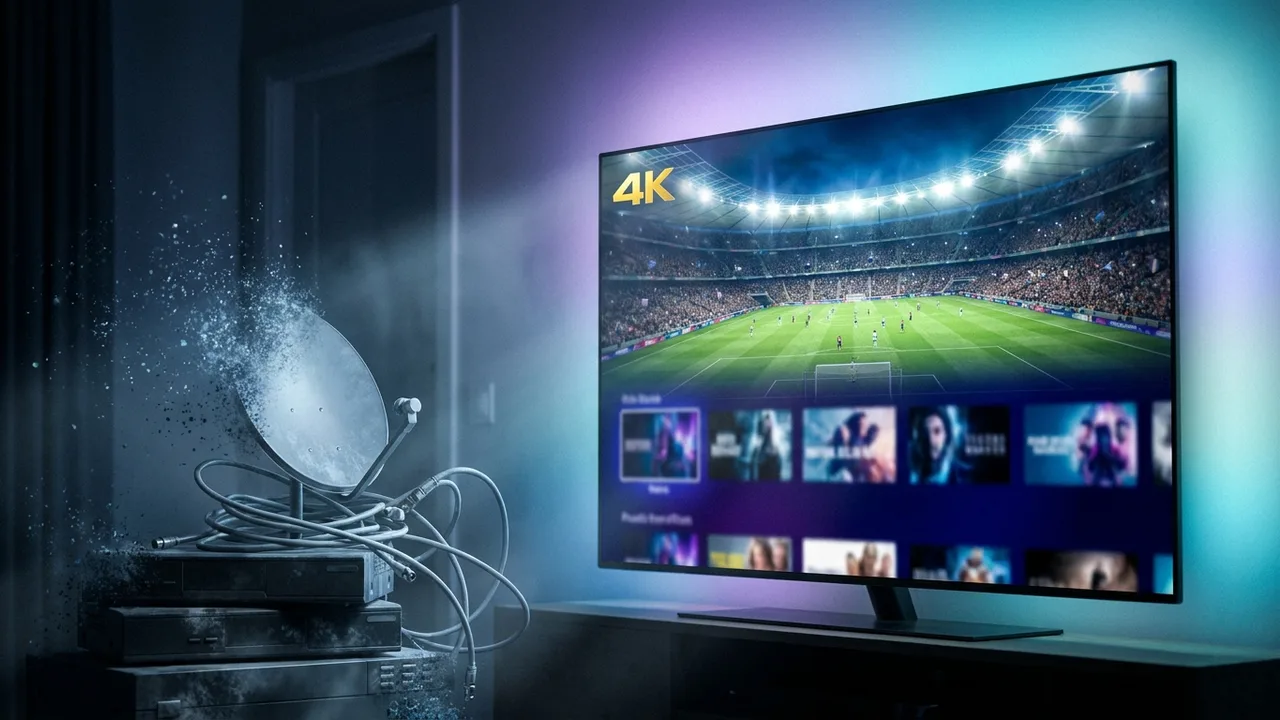
The short version: IPTV drops the dish, the engineer visit and the rain fade, and works on every screen in the house for a fraction of the price. Satellite still earns its place where broadband is weak or missing. Here is the honest side-by-side — including where satellite genuinely wins.
- No dish, no engineer, no weather loss — IPTV arrives over your internet line, not the sky.
- One IPTV login runs on any TV, stick, phone or laptop; a dish is fixed to one roof.
- Satellite wins in one case only: no reliable broadband, where a clear view of the sky beats a slow line.
The side-by-side
| Satellite TV | IPTV subscription | |
|---|---|---|
| Hardware needed | Dish, receiver box, cabling, roof access | A small stick or your existing Smart TV |
| Installation | Engineer visit, drilling, alignment | Plug in, sign in — no engineer |
| Weather | Rain & snow cause signal loss | Unaffected — travels down a cable |
| Channels | Fixed package tiers | 20,000+ on one login |
| Films & series | Limited on-demand | 60,000+ VOD titles included |
| Where it works | One fixed room, one house | Any screen, any room, another address |
| Cost | Package + line rental, rises yearly | from ~€4.92/month billed yearly |
| Needs | Clear view of the sky | A decent internet connection |
Where satellite TV genuinely wins
It would be dishonest to pretend satellite has no strengths. In a few situations it is still the right call:
- No decent broadband — a rural home with a slow or non-existent line can point a dish at the sky and get television anyway. This is satellite's one clear advantage.
- Zero internet dependency — the signal doesn't share a household connection, so it never competes with someone else streaming, gaming or on a video call.
- Set-and-forget — once a dish is aligned it needs no logins or app updates, which suits homes that want the simplest possible remote.
Where IPTV wins
- No dish, no install, no drilling — nothing is bolted to the wall or roof, so there is no engineer visit and nothing to remove when you leave.
- No weather loss — the "signal lost" screen in the middle of a rainy match simply doesn't happen over a cable.
- It goes where you go — the same login runs on a new house or a stick in your suitcase, unlike a fixed dish. More on that in using IPTV on holiday.
- Every screen, not one room — phones, tablets and laptops all work, not just the TV wired to the receiver. Pick your box in our best devices guide.
- More for less — one plan covers 20,000+ channels and a large film library; the full value maths is in is IPTV worth it?
The honest trade-off. Satellite's weak spot is the sky; IPTV's weak spot is your internet line. Where satellite drops out in heavy rain, IPTV can stutter on a congested connection at peak time — that's why some homes notice evening freezing. Both have a limit; IPTV's is far easier to fix.
Switching from satellite to IPTV
The move is simpler than most people expect, because there is nothing to uninstall first — you keep the dish in place and run IPTV alongside it for a month if you want to be sure.
- Check your line. Run a quick speed test: ~10 Mbps carries HD, ~25 Mbps carries 4K. Full detail in the speed guide.
- Confirm your must-have channels. List the ones you'd miss and check they're covered before you pay a cent.
- Plug in a device. A cheap stick turns any TV into a Smart TV — no receiver, no aerial, no drilling.
- Run both side by side. Keep satellite for a month, watch IPTV in parallel, then cancel the one you no longer open.
The same overlap-then-cancel plan works for cable too — see how to switch from cable to IPTV and the full cost breakdown in IPTV vs cable & streaming.
Frequently asked questions
Is IPTV better than satellite TV?
For most homes, yes on cost and flexibility: no dish, no engineer visit, no weather drop-outs, and it works on any screen in the house. Satellite still wins where broadband is poor or unavailable, since a dish needs only a clear view of the sky, not an internet line.
Does IPTV work without a dish or aerial?
Correct — IPTV is delivered over your internet connection, so there is no dish, no cabling and no roof access. You plug a small streaming device into any TV, or use an app on a Smart TV, and the channels arrive over Wi-Fi or Ethernet.
Does bad weather affect IPTV like it affects satellite?
No. Satellite signals fade in heavy rain or snow (the classic "signal lost" screen mid-match). IPTV travels down a cable, so weather is irrelevant — its equivalent weak spot is a slow or congested internet connection, not the sky.
Can I move IPTV to another house or take it abroad?
Yes. There is nothing bolted to the wall — the same login works on a new address or a stick packed in your suitcase, as long as there is a decent connection. A satellite dish stays where it was installed.
If your home has a reasonable internet connection, IPTV beats satellite on almost every axis — no dish, no engineer, no weather drop-outs, every screen covered, and a much lower price. Satellite keeps one real advantage: it works where broadband doesn't. For everyone else, the dish is doing a job a small stick now does better.